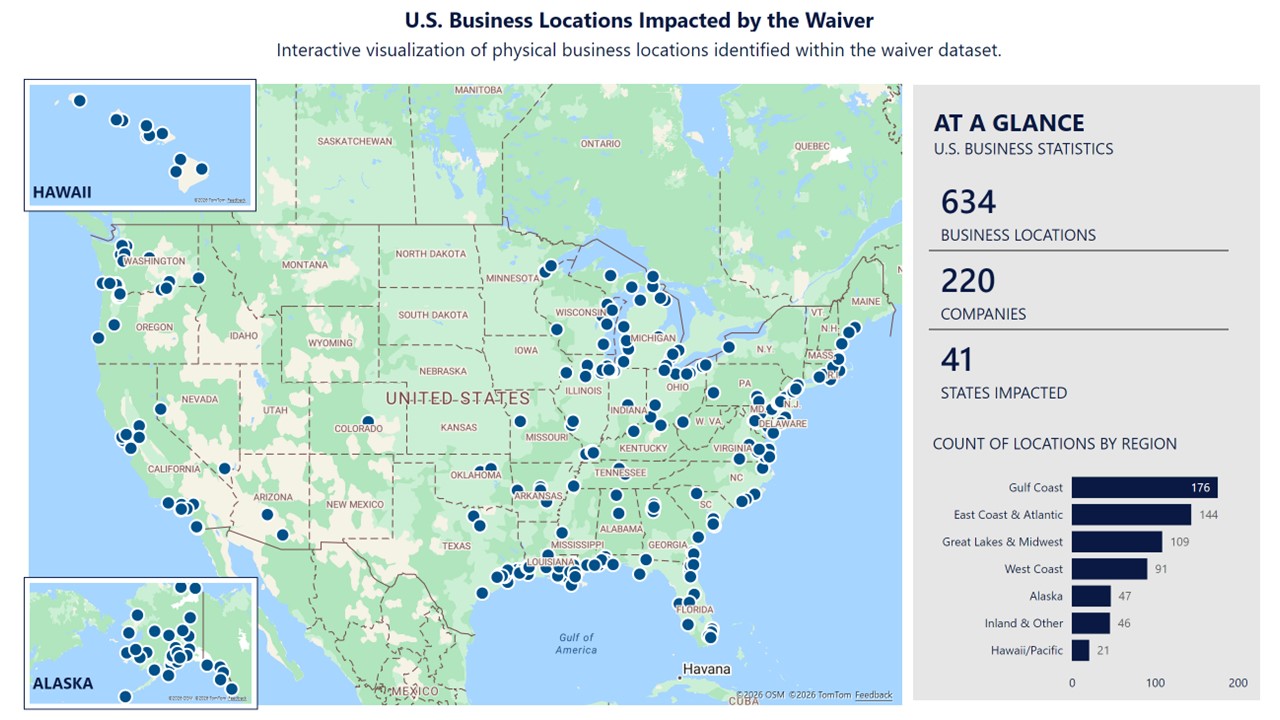

On May 8th, 2026, SCA joined a letter urging the Congress to reject any extension of the current blanket Jones Act waiver. The letter was signed by more than 120 Executives and leaders from maritime organizations around the country, including SCA. The data above represents the companies, including subsidiary companies, who signed the letter. Below is the text of the letter shared with Members of Congress.
Our firms sustain shipbuilding, maritime commerce, energy infrastructure and domestic supply chains across all fifty states. We urge Congress, in the strongest possible terms, to reject any extension of the blanket Jones Act waiver issued on March 17, 2026 and to allow it to expire as scheduled.
The Waiver Has Not Lowered Gas Prices
The waiver was issued in response to energy supply disruptions from the conflict in the Middle East and the closure of the Strait of Hormuz, with proponents promising relief at the pump. That promise has not been fulfilled. Gasoline prices have increased in every U.S. market since the waiver was issued – including markets not even serviced by Jones Act vessels.
The primary driver of gasoline prices is the cost of crude oil on global markets, not domestic shipping logistics. In fact, Maritime Administration data suggests that foreign companies are engaging in disaster arbitrage – exporting American energy products overseas at higher world prices rather than relieving domestic consumers. U.S. fuel price issues are due to lack of availability, not challenges of Jones Act transportation.
The Waiver Benefits Foreign and Chinese-Connected Operators – Not American Workers
The waiver’s principal beneficiaries are not American workers or consumers – they are foreign and adversary-connected operators. MARAD data as of May 7, 2026, reveals that approximately 29 percent of completed waiver voyages involved vessels with ties to the People’s Republic of China — whether through owner/operators headquartered in or jointly owned by Chinese entities, or through vessels constructed in Chinese shipyards. Additionally, 95 percent of completed voyages directly benefit foreign maritime companies that pay no federal or state taxes, do not comply with U.S. immigration laws, Coast Guard safety regulations, giving them a built-in cost advantage over American companies in American waters.
Allowing Chinese-affiliated operators and Chinese-built vessels to capture market share in American coastwise trade — under a waiver issued for national defense during a time of war— undermines the Administration’s stated policy of restoring America’s maritime dominance and national security and constitutes profiteering by opportunistic oil traders and foreign shipping companies
Private Capital Is Flowing to American Shipyards – The Waiver Threatens It
The Jones Act is fueling a historic resurgence in American commercial shipbuilding. Since January 2024, U.S. shipyards have secured more than $2.8 billion in disclosed commercial vessel contracts These orders are not projections. They are real capital deployed on the strength of the Jones Act’s legal framework.
Extending the waiver sends exactly the wrong signal. A major U.S. maritime investment platform has already halted a planned approximately $1 billion capital raise as a direct result of the waiver’s policy uncertainty. Conversations with U.S. shipyards regarding domestic tanker fleet recapitalization have stalled and infrastructure investments— new docks, assembly facilities, and workforce training programs— are jeopardized when investors, lenders, and workers are told that the domestic market can be opened to foreign competition at any time by executive action.
The Waiver Creates Border and Immigration Security Risks
Foreign-flagged vessels are not subject to the same rigorous crew vetting, documentation, and labor standards required of U.S.-flag operators. Granting foreign-crewed vessels — including Chinese-connected operators — routine access to U.S. coastal waters, inland waterways, and sensitive energy infrastructure creates exploitable seams in border and port security, expanding the thread for human smuggling, contraband introduction, and intelligence collection. Sustaining the waiver effectively exempts significant commercial maritime activity from the immigration and security controls prioritized across every other domain of entry.
The Jones Act Is an Economic Engine and a National Security Imperative
The Jones Act sustains nearly 650,000 American jobs, generates approximately $154 billion in annual economic output, and provides roughly $41 billion in labor compensation — all at zero cost to the federal government.
A fleet of more than 40,000 American-built vessels moves nearly one billion tons of cargo annually along inland waterways, across the Great Lakes, and over the oceans to Hawaii, Alaska, Puerto Rico, and U.S. territories, with each shipyard job creating four additional jobs elsewhere in the economy.
Claims that Jones Act shipping costs are prohibitively high ignore the artificial cost advantages foreign operators enjoy — paying no U.S. taxes, disregarding U.S. immigration and labor laws, and often receiving direct government subsidies — while American operators compete under the world’s highest safety and environmental standards. Indeed, Jones Act operators maintain long-term charters that have not spiked like global charter rates have; in fact, Jones Act rates have remained stable and in most instances are lower than foreign shippers using the waiver.
The Jones Act is not merely an economic statute; it is a cornerstone of American national defense.
The Waiver Undermines the Administration’s Call for Maritime Dominance
The Administration recognized this reality when President Trump signed Executive Order 14269, “Restoring America’s Maritime Dominance,” on April 9, 2025, and released the resulting Maritime Action Plan (MAP) in February 2026. The MAP calls for expanded U.S.-flag fleet growth, a universal port fee on foreign-built vessels, modernized mariner credentialing, recapitalization of the Ready Reserve Force, and establishment of a Maritime Security Trust Fund (MSTF) for domestic shipbuilding. The Administration’s FY2027 budget request includes $65.8 billion for U.S. Navy shipbuilding — the largest naval construction ask in over six decades — and $1.4 billion for the MSTF to support this executive action. As the Administration testified before Congress, “Shipbuilding is not an independent driver of maritime power. It is a downstream output of a functioning maritime system… sustained shipbuilding activity is a function of continuous vessel deployment, which itself depends on predictable cargo demand.” Allowing foreign shippers with built-in cost advantages to underbid U.S. operators kills new domestic commercial shipbuilding contracts and outsources predictable cargo demand.
Extending the Jones Act waiver directly contradicts every one of these objectives.
A Call for Leadership
The Jones Act is the quintessential “Buy American, Hire American” law. It protects American jobs, sustains American shipyards, trains American mariners, and ensures that our armed forces will never depend on foreign vessels to defend our shores or supply our troops. Temporary waivers should remain precisely that: temporary. They must not become a mechanism for permanently undermining the legal framework upon which billions in private investment and hundreds of thousands of American livelihoods depend.
For all of these reasons, we respectfully and urgently call on Congressional leadership to reject any extension or renewal of the Jones Act waiver and to allow the waiver to expire on its terms on May 17.